
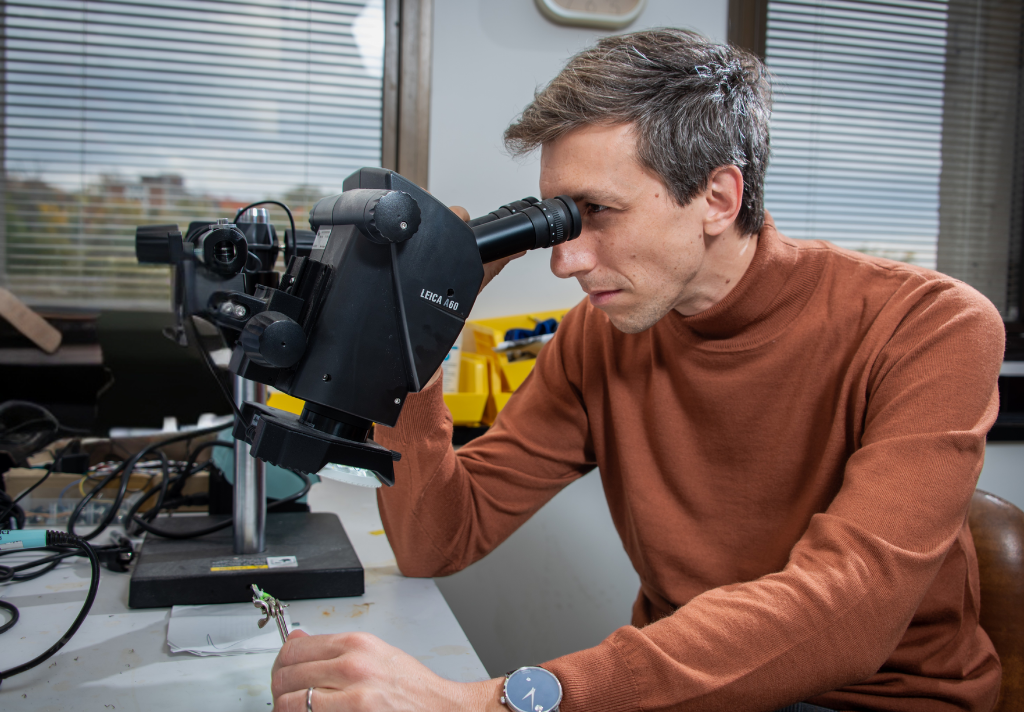
Adrien Peyrache is an Associate Professor at McGill University and leads the Peyrache Lab at The Neuro (Montreal Neurological Institute-Hospital). His research examines how the brain creates internal representations of the world that support navigation, memory, and the reorganization of information during sleep.
Peyrache also co-founded the Québec Sleep Research Network, which advances
collaborative, inclusive, and intersectoral research on sleep and circadian rhythms.
A TACC Regular Member since 2022, Peyrache investigates whether some of these foundational neural processes develop differently in conditions associated with autism. Using genetically modified rat models, his team studies the development of brain circuits involved in spatial orientation and internal representations of the environment.
Adrien Peyrache shares what drives his passion for investigating the brain’s internal compass. (Production: Aura Strategies, 2023)
What motivates you in your work?
Peyrache: Curiosity and discovery.
What sparked your interest in research related to neurodevelopmental conditions, including autism?
Peyrache: I remember reading a book by the autistic author Donna Williams as a teenager. It struck me. Her story opened my eyes to what autism is, the struggle to communicate with others, the overwhelming emotions.
As I embarked on an academic journey in neuroscience, I became fascinated by fundamental questions regarding memory and sleep. The only neurological disorder I was interested in was epilepsy as, in my opinion, this was the only disease with appropriate animal models.
A few years after I started my lab, a postdoc, Dr. Adrian Duszkiewicz, convinced me to submit a seed grant for a collaboration between McGill and the University of Edinburgh, in which we aimed to explore how the spatial navigation system developed in Fragile X (FMR1-KO) rat models. What we saw in the data immediately sparked our interest. In many regards, the system was developing faster and better in the transgenic rat before deteriorating in adults.
We then obtained a grant from the Simons Foundation to continue this work, which is still ongoing.
To me, studying autism is a unique opportunity to understand how the brain develops, in a typical or divergent manner.
What are your research goals?
Peyrache: My goal is to establish the head-direction system, that is the brain’s compass, as a model of choice to study autism in animal models.
Not only it is a fascinating system that allows to easily bridge the gap between neuronal coding and naturalistic behaviour, it also shows highly organized activity during sleep – and sleep disorder is another aspect of autism that is too often overlooked.
Stay up to date
Connect with Prof. Peyrache and learn more about his work through his LinkedIn, GoogleScholar and lab website.