
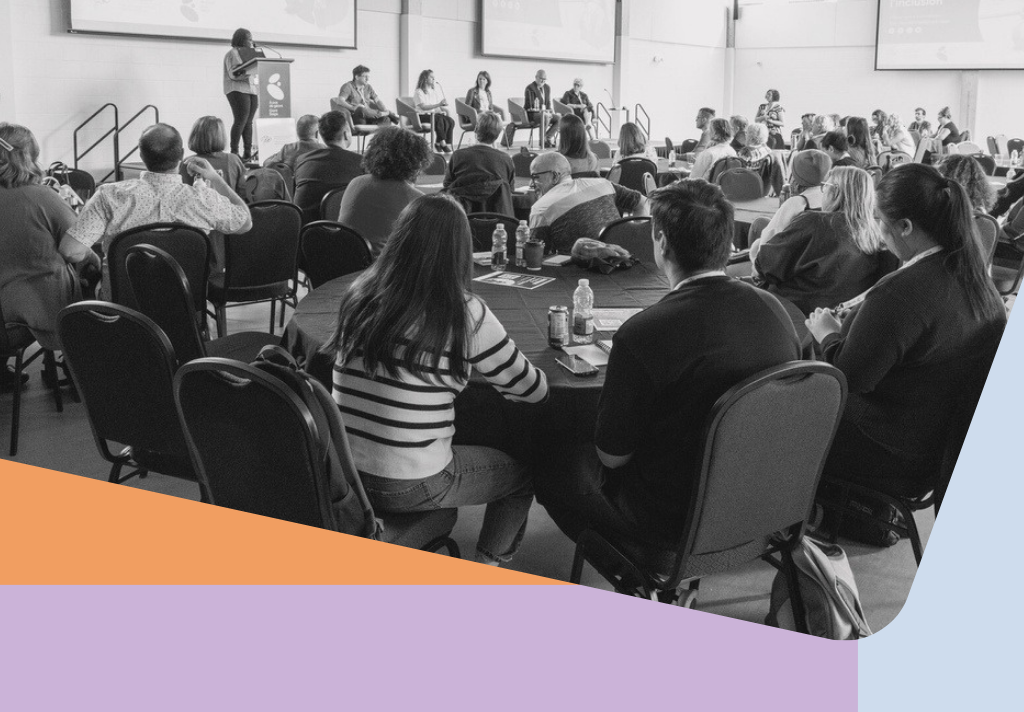
Presented by Giant Steps in partnership with the Transforming Autism Care Consortium (TACC), Neurodiversity in Action: Voices, Evidence, Inclusion took place on March 20 and 21, 2026 at the Giant Steps Centre. The event brought together a range of perspectives through keynotes, panels, research presentations, and cultural experiences.
Discussions focused on care across the lifespan, education, passion, and self-determination. Contributions from speakers and participants supported open, grounded exchanges and practical insight.
The event strengthened connections across sectors and highlighted the importance of inclusive, neurodiversity-affirming practices, reflected across TACC initiatives including the Giant Steps Living Lab, Partners for Change, and the Autism Festival.
Session recordings are available below and on our YouTube channel.
Welcome and Opening Remarks
Speakers: Alain Beaudoin, Thomas Henderson, Senator Tony Loffreda, Helena Lalo
Keynote | Autism Beyond Awareness: Media, Inclusion, and Authenticity (in French)
Speakers: Charles Lafortune, Sophie Prégent, Isabelle Courcy, Jonathan Gray, Mathieu Caron, Catherine Proulx, and Georges Huard
This session explores how media representations of autistic people influence awareness, inclusion, and social acceptance. Following a keynote by Sophie Prégent and Charles Lafortune, a panel of experts, creators, and autistic individuals will discuss the impacts, challenges, and opportunities related to authentic and neuroinclusive representation. An essential conversation for rethinking practices and fostering more inclusive communities.
Positive Mental Health and Autism: Toward Inclusive and Affirming Practices (in French)
Speakers: Anne-Marie Nader, Alexis Beauchamp-Châtel, Mathieu Giroux, Véronique Richard
This session explores how to promote positive mental health among autistic people through neuroaffirming approaches. Speakers will share research-based strategies and lived experience perspectives to support well-being, reduce stigma, and create inclusive environments.
Healthy Sexuality and Education for Autistic Students
Speaker: Isabelle Hénault
This session explores what it means to have specific developmental needs related to sexuality, and how these needs can shape young people’s experiences and understanding of relationships. It presents practical ways parents and professionals can support students in developing healthy relationships and a positive, informed approach to sexuality. The session also highlights available resources and educational supports, and participants will receive a comprehensive toolkit with curated links, resources, and programs.
Toward neuroinclusive schools: A collaborative approach to reducing barriers (in French)
Speakers: Marie Grandisson and Claire Piquemal
This session presents a collaborative approach to neuroinclusive schools, emphasizing changes to school environments and activities. The approach aims to support well-being and meaningful participation for a greater number of neurodivergent students. Highlights from a pilot project and concrete examples from a regional autism-mandated school will be shared, and participants will reflect on changes they could implement in their own schools.
Supporting Adolescents in the Transition to Adulthood
Speaker: Mélanie Couture
This presentation offers guidance on supporting adolescents as they transition to adulthood. It addresses effective attitudes for fostering autonomy and maximizing potential, introduces the School-to-Work Transition (TÉVA) approach, and explains how parents and professionals can support successful, respectful integration aligned with young people’s interests and capacities.
Connecto: A practical tool to support autistic students in understanding themselves (in French)
Speaker: Martine Gauthier
This presentation showcases the Connecto toolkit: the result of collaborative, cross-sector work involving professionals from various fields and an autistic contributor, bridging research and real-world practice. Designed to support autistic students, it provides a concrete framework for promoting body awareness, self-understanding, and progression toward self- or co-regulation. It also supports collaborative analysis of student profiles and reflective practice, strengthening professional confidence.
Cultural Activity with Nico B. Manzi
Artist: Nico B. Manzi
Caregiver Skills Training Canada – Progress and Next Steps
Speakers: Mayada Elsabbagh, Marla Cable, Rebecca Fenton, Shobi Jeyachandran, Eileein Jeevakumar, Mehdi Ghanadzade
The Caregiver Skills Training (CST) program was developed by the World Health Organization to support parents and caregivers of young children with socio- communication delays by using evidence-based strategies to promote shared engagement, social skills, and positive behaviors through everyday play and activities. This panel will present the CST program, progress and outcomes from the Canadian research initiative, and pan-Canadian perspectives on implementation.
Perspectives on Early Autism Intervention and Support for Kids and Families in Quebec: Towards Inclusive Support that Meets the Needs of Children and their Families
Speakers: Isabelle Préfontaine, Tania Shand, Julie Turgeon, Ina Winkelmann, and Reeta Hsanen
This panel presents diverse approaches to early intervention and family support, drawing from research, service delivery, and lived experience. Panelists will discuss challenges and opportunities related to implementation in Quebec and how research can support the development of inclusive approaches.
Film screening: Ben’s Animals
The session begins with an introduction by Julie Chou and Benjamin LaChapelle, followed by the screening of Ben’s Animals (45 minutes, CBC Gem), a deeply human documentary following Benjamin, an autistic young man whose passion for animals shapes his daily life, relationships, and connection to the world. The film explores creativity, perseverance, and identity, highlighting the central role of interests in personal flourishing.
View the documentary for free on CBC Gem: https://gem.cbc.ca/absolutely-canadian/s25.
When Passions Take Shape: Perspectives on Autistic Interests and Well-Being
Moderators: Martine Habra, Thomas Henderson
Panelists: Isabelle Soulières, Hugo Lamoureux, Dan Ten Veen (Spectrum Productions), Ross White, Benjamin Lachapelle, Julie Chou, Evan Beloff, and Noah Leon
This bilingual session brings together cross-sector perspectives on the role of passions, interests, and talents in the lives of autistic people. Following the screening of Ben’s Animals, panelists will share reflections grounded in lived experience, research, practice, and community contexts, concluding with an open discussion with the audience.
The Giant Steps Living Lab is a partnership between the Giant Steps Centre and the Transforming Autism Care Consortium (TACC) that connects research with everyday experience. Based at the Giant Steps Centre for Autism in Montreal, the Living Lab brings together researchers, educators, families, and community partners to co-create tools and practices that foster learning, inclusion, and quality of life for autistic people.
For more information, contact: recherche@giantstepsmontreal.com