
Marie Grandisson is a professor at Université Laval’s School of Rehabilitation Sciences. An occupational therapist by training, she is also a researcher at the Centre for Interdisciplinary Research in Rehabilitation and Social Integration and the Centre de recherche en autisme et en déficience intellectuelle.
Her research examines how everyday environments can better support the participation and well-being of neurodivergent children and youth. She explores their experiences at school, in rehabilitation services and within their families, and the changes that could improve those experiences.
Prof. Grandisson leads the Inclusive Communities Lab, where research involves the people whose lives and work it concerns, including young people, families, clinicians and managers. The team uses creative, participatory methods to make research more accessible and help people contribute to studies that affect their lives.
A TACC Regular Member since 2024, Marie also serves on the TACC–CanNRT Committee on Inclusive Research Methods. She contributes to developing training, resources and practices that support the meaningful participation of neurodivergent people in research.
How did your background lead you to research neurodevelopment and inclusion?
Grandisson: In my first jobs, I supported autistic young people and young people with an intellectual disability. I later worked with these populations as an occupational therapist. When I became a professor, I saw an opportunity to bring together my experience in research, occupational therapy and community health to help make society more inclusive. I wanted to help create conditions that support the well-being of these young people and their families from the outset.
What keeps you committed to this work?
Grandisson: My interactions with neurodivergent young people and their families keep me motivated. Their stories move me and push me to do more to improve their everyday experiences, so they don’t have to fight so hard against systems that aren’t inclusive enough.
When clinicians take an interest in my research, that also encourages me to keep going. It tells me that the work resonates with people who can put it into practice and make a difference.
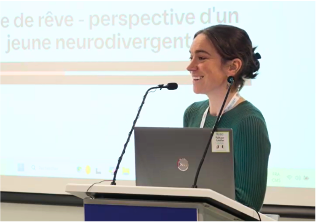
Marie Grandisson and Claire Piquemal present Towards Neuroinclusive Schools at the Neurodiversity in Action Symposium (2026).
What changes do you hope your research will help bring about?
Grandisson: I hope to make a difference for neurodivergent children and their families by helping improve their experiences in schools and rehabilitation services. I want to use research and share what we learn to help create a society where neurodivergent young people and their families can feel well and thrive.
Could you tell us about some of the Inclusive Communities Lab projects?
Grandisson: Our projects focus on supporting families and schools. FORCES looks at support for families, and we share more about this work in a second video. Through Towards Neuroinclusive Schools, we explore ways to make school environments more inclusive. We discuss this work in a project video and in our presentation at the Neurodiversity in Action symposium.
With Nina Thomas, I also led the participatory research project Militer malgré nous. We documented the steps neurodivergent young people and their families have to take to have their needs and rights recognized in high school. By sharing their experiences, we hoped to encourage dialogue and work together to create more inclusive schools. The project received its initial support through the pilot phase of TACC’s Partners for Change program.
Learn more about the project Militer malgré nous through the testimony of a participating student and a presentation by Marie Grandissons. © Université Laval
Connect with Marie
Contact Professor Grandisson by email or connect with her on LinkedIn.
To follow her team’s work, visit the Inclusive Communities lab’s website, Facebook page and YouTube channel, or view her ORCID profile.