
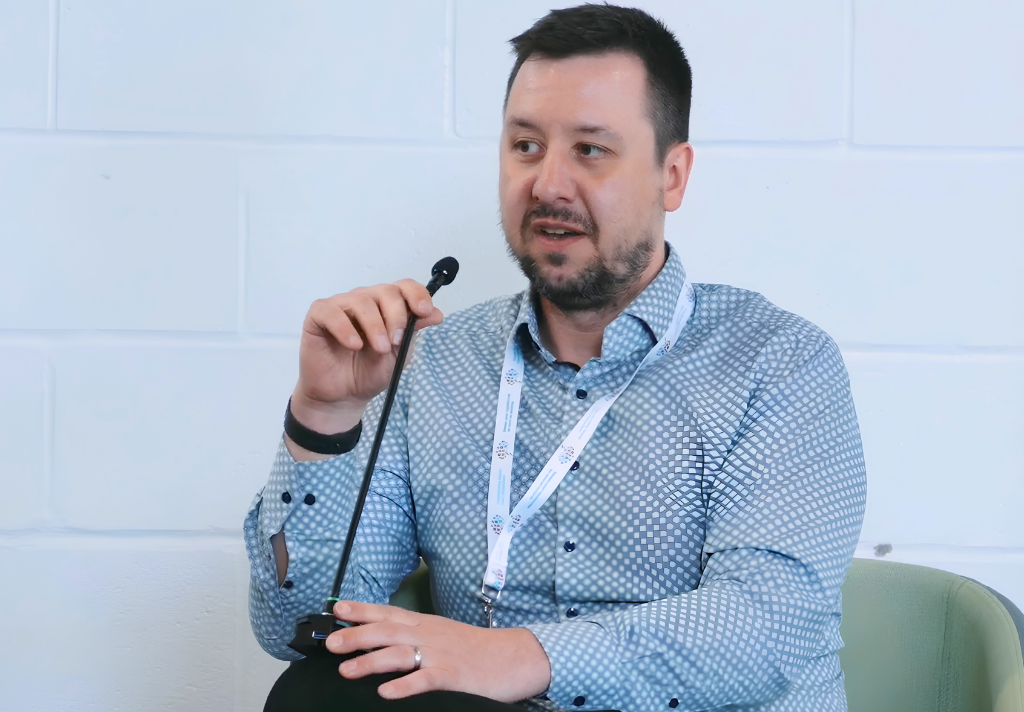
Improving mental health care for autistic adults and people with intellectual disabilities is a focus of Alexis Beauchamp-Châtel’s work.
Dr. Beauchamp-Châtel is a psychiatrist with the Programme de psychiatrie neurodéveloppementale adulte (PPNA) at the Institut universitaire en santé mentale de Montréal, part of Santé Québec – Est-de-l’Île-de-Montréal. He is also an associate researcher at the institute’s research centre and a clinical assistant professor in the Department of Psychiatry and Addiction at Université de Montréal. He has been a Regular Member of TACC since 2019.
Drawing on his clinical experience, he studies ways to better support autistic people and people with intellectual disabilities who also experience mental health or behavioural difficulties. His goal is to contribute to more targeted interventions, better living conditions, and greater opportunities for social inclusion.
What sparked your interest in neurodevelopmental research?
Beauchamp-Châtel: I have worked with autistic people and people with intellectual disabilities since 2011, beginning during my psychiatry residency.
Throughout my practice, I have supported people who also experienced mental health or behavioural difficulties, including in institutional settings. These experiences motivated me to improve their living conditions, including by supporting their return to community living.
I want to contribute to more targeted care that responds to their needs and supports their social inclusion.
In this ECHO® CHUM telementoring presentation, Dr. Beauchamp-Châtel discusses substance use, addiction, mental health, and access to inclusive services adapted to neurodivergent people’s needs. Video shared by CECTC.
What motivates you to develop new approaches and tools in research and clinical practice?
Beauchamp-Châtel: Research offers the opportunity to provide autistic people and people with intellectual disabilities with approaches and tools that can improve their quality of life and social inclusion. I am also motivated by seeing the benefits firsthand in my clinical practice, among the people I support.
Learn more about neuroaffirming approaches and how they can support autistic people’s mental health during a panel discussion at the Neurodiversity in Action symposium (2026).
What are your current research projects?
Beauchamp-Châtel: My research covers several aspects of care and support for autistic adults.
In digital mental health, we are gathering perspectives from autistic people and professionals on the use of a mental health app. We are also reviewing research on digital well-being apps for autistic people. Another review is in preparation, examining how apps and wearable devices can collect information about mental health symptoms.
We are also preparing a retrospective study of adult autism assessments conducted by a multidisciplinary team between 2017 and 2026.
Another project in development will evaluate the effectiveness of the PPNA mobile team as an alternative to hospitalization. This work is part of the doctoral research of a psychology student I supervise.
Finally, I am involved in a planned randomized clinical trial evaluating the effect of nabilone on aggression in autistic adults, in collaboration with the Centre for Addiction and Mental Health (CAMH). The project has received funding from the Canadian Institutes of Health Research. We are preparing the study protocol for submission to our centre’s research ethics committee.
What change do you hope to help create for people with neurodevelopmental conditions?
Beauchamp-Châtel: I want to help people with neurodevelopmental conditions have a satisfying quality of life and be included in society.
Connect or Collaborate
Trainees, community members, and professionals interested in connecting with Alexis Beauchamp-Châtel can contact him by email or follow his work on LinkedIn and Google Scholar.