
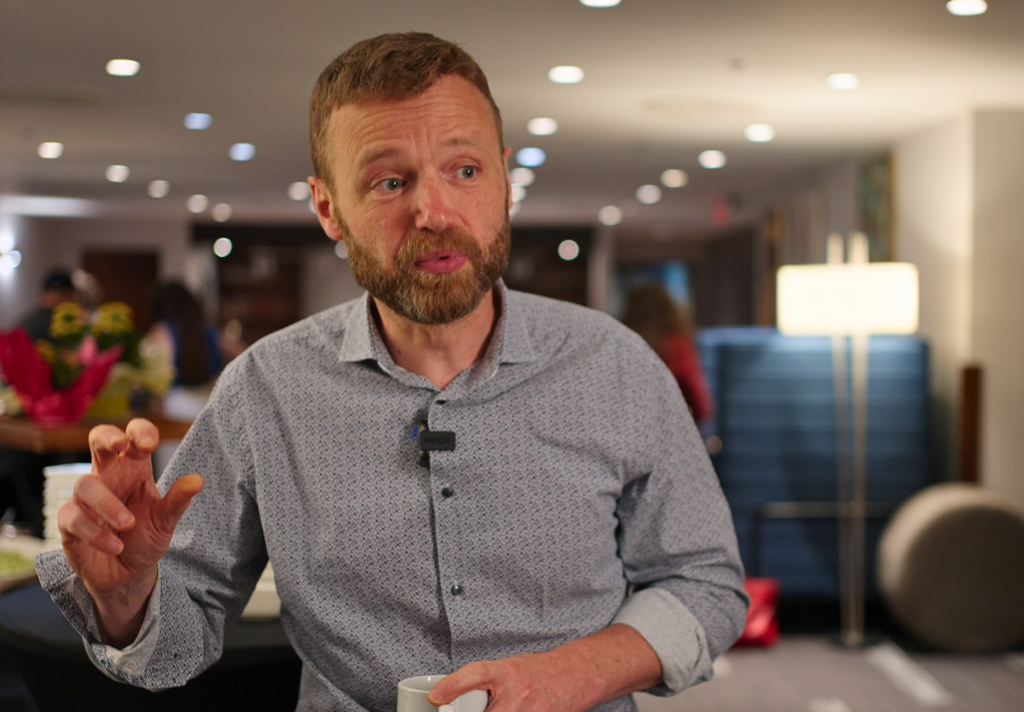
Baudouin Forgeot d’Arc is a child psychiatrist, researcher, and Head of the Department of Psychiatry at the CHU Sainte-Justine, as well as a full professor in the Department of Psychiatry at the Université de Montréal. His work sits at the intersection of pediatric mental health, neurodevelopment, implementation science, and systems transformation, with a focus on improving how care is delivered for autistic people, youth, and families.
Through his clinical, research, and leadership roles, Dr. Forgeot d’Arc works to reduce the gap between what is known through research and what is experienced in practice. His projects explore topics ranging from professional training and care pathways to ethics, artificial intelligence in youth mental health, and collaborative approaches to continuous improvement in care systems.
As a member of the Transforming Autism Care Consortium (TACC) since 2017 and a member of its Scientific Committee, he contributes to the network’s scientific orientations and priorities, reflecting his longstanding commitment to advancing collaborative approaches that improve quality of life for autistic people and individuals with neurodevelopmental conditions.
What first led you to neurodevelopmental research?
Forgeot d’Arc: What first drew me to neurodevelopmental research was a deep fascination with the diversity of how the human mind works, along with a desire to help people facing significant challenges and hardship.
What drives your work today?
Forgeot d’Arc: Today, what motivates me is the possibility of contributing to meaningful change: tangible improvements for individuals, families, and care environments.
Part of that work involves narrowing the gap between what we already know through research and what is actually being done in practice.
My approach is grounded in knowledge implementation, continuous improvement, and the development of learning health systems.
What areas of work and collaboration are you currently focused on?
Forgeot d’Arc: My current projects are generally situated within pediatric mental health. They include work on implementing artificial intelligence in youth mental health care, developing care pathways related to ethics and Tourette syndrome, and training professionals to improve the care and support offered to autistic people.
These projects are supported in part through the Department of Psychiatry at CHU Sainte-Justine and through the team we now call la Fabrique — a research and innovation group focused on transforming youth mental health care by bringing together people who are motivated to build and improve systems collaboratively.
For those interested in training opportunities, there is also the Programme ECHO santé mentale en neurodéveloppement, as well as the upcoming PASSS — Pouvoir d’agir et soins sans stigma program.
How do you hope this work will influence care and practice?
Forgeot d’Arc: I hope this approach has a direct impact on my clinical practice by helping improve both the quality of care and the concrete outcomes experienced by the patients I work with every day.
As a manager and project lead, I also hope some of these improvements can contribute more broadly across the health care system, and in some cases even at the network level.
What role does collaboration play in your involvement with TACC?
Forgeot d’Arc: I joined TACC from the very beginning because I strongly believe in collaboration. I also believe that a system is only as strong as the energy and resources people choose to invest in it.
I want to contribute my own energy and resources to a collaborative system where, together, we can achieve more than any one person could accomplish alone.
Baudouin Forgeot d’Arc speaks at the 2025 TACC Member Assembly on the importance of bringing together researchers, clinicians, community members, and people directly impacted by research to strengthen learning health systems and create meaningful improvements in care, services, and quality of life. (Noah Leon, 2025)
Connect with Dr. Forgeot d’Arc
Students or community members who would like to get in touch with Dr. Forgeot d’Arc or explore opportunities for collaboration can write to him directly at baudouin.forgeot.darc.med@ssss.gouv.qc.ca, or his research coordinator, Manon Dambrun.